

abortion mathematics
a tale of two rosaries

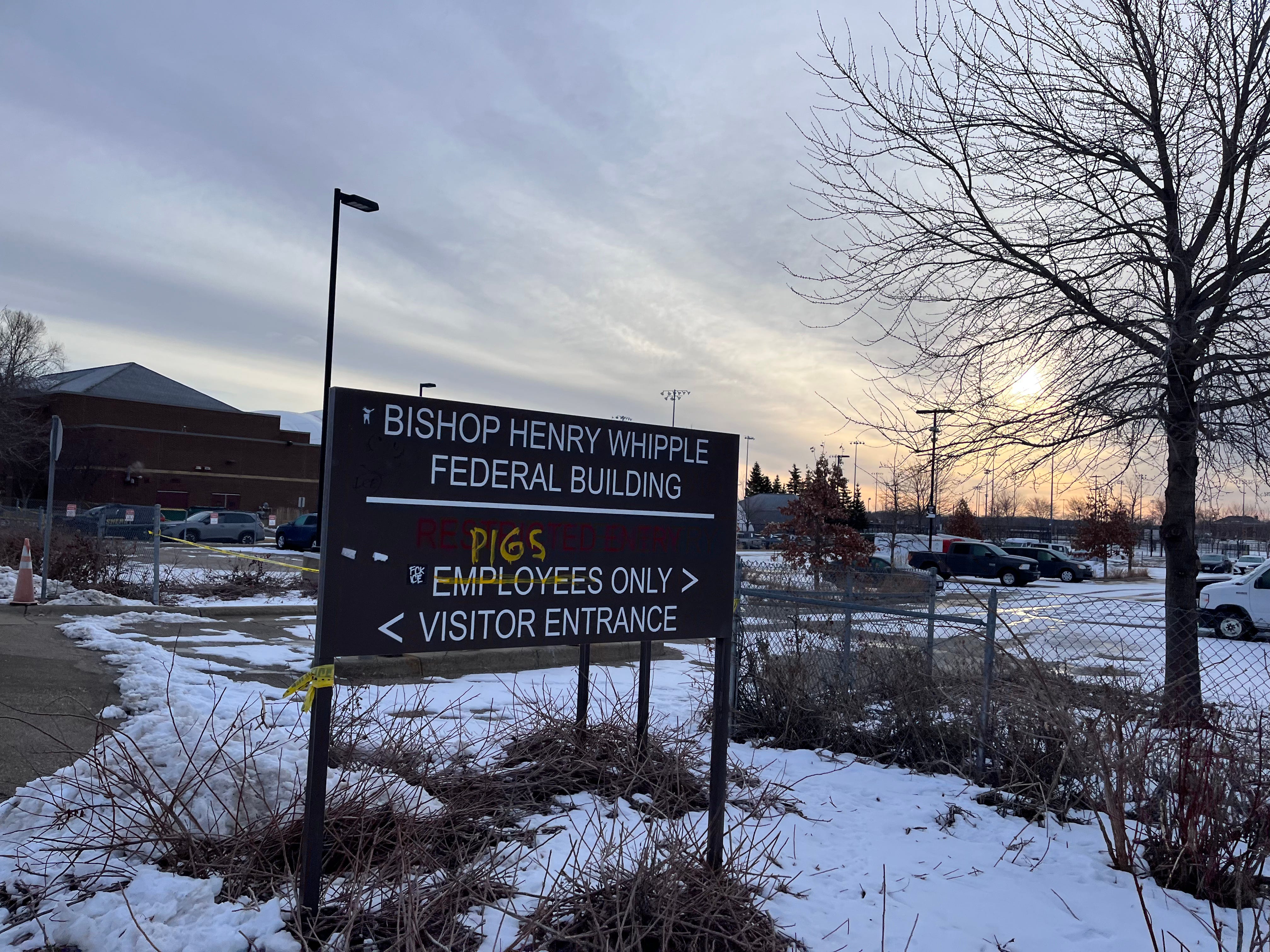
On Friday, my friend T invited us to pray a rosary at Bishop Henry Whipple Federal Building at Fort Snelling.
As a child, Fort Snelling was where you went for historical reenactments about the Northwest Passage, voyageurs, and the fur trade. I remember learning a lot about beaver furs, and not a lot about the role that the fort played in the white settlers’ war with the Dakota in 1862.
The Bishop Henry Whipple building was named for the first Episcopal bishop of Minnesota. Senator Walter Mondale named the building for Whipple in 1969, four years after it was erected. The invocation of Mondale, the vice president of the nicest U.S. president, Jimmy Carter, and the idea that an episcopal bishop would be honored by his name on a federal building harkens back to more civilized times, maybe. Or a time where we hoped for civilization.
Perhaps civilized is too strong a word. Whipple interceded with President Lincoln for a pardon for the more than 300 Dakota sentenced to death in the war of 1862. He was successful, to a degree. Still, the U.S. Army massacred 38 Dakota prisoners, the largest mass execution in American history, downriver from the fort, in Mankato, on the day after Christmas, 1862. Fort Snelling was a site of displacement, where the native Dakota were shipped out of Minnesota. Since the creation of the Department of Homeland Security, the Whipple building has housed the department’s offices and served as an ICE field office in the Twin Cities.
The episcopal church and the Interfaith Coalition on Immigration petitioned to have Whipple’s name removed from the building in 2019. “What is happening to immigrants in the Bishop Henry Whipple Federal Building is in direct opposition to the values, theology and policy of the Episcopal Church,” an Episcopal clergy representative said at a press conference launching their “What Would Whipple Do?” campaign.
The building, according to an Indigenous news outlet, is on the site of a former concentration camp where roughly 2,000 Dakota were imprisoned at Fort Snelling, most of them non-combatants. It is a dark history for a building that has a dark present.
During “Operation Megro Surge,” an estimated 3,000 immigrants were held for varying lengths of time in the building. A woman detained there tells the absolutely appalling story of being shackled at the ankles and locked in a bathroom with two men, with a working toilet but no working sink. She was held there for 24 hours.
On January 12, a maze of concrete barriers and eight-foot chainlink fencing was installed around the road leading to the building and its parking lot.
The fencing created a physical border along the spiritual divide of “This is ours, that is yours.” It incarnated the linguistic divide of “us vs them.” Although the taxpayers protesting outside own the building, they have paid the $14 million in taxes to build it and the taxes to renovate it, the barricade created a fortress government waging a war against its own citizens outside, holding taxpayers prisoner inside a cell their taxes paid for. The fence declares neighbors enemies. I was reminded of a chilling photograph of the new border fence between Poland and Belarus that Elizabeth Flock reports on in The New Yorker.
The border created a “front line” for the press-gang of ICE agents to protect. After the fencing was installed, the road became off-limits to protestors, who had to stay on the sidewalk, behind the barricades. ICE agents yelled at protestors and warned them not to enter the roadway, observers told me. Members of the church who were praying the rosary told us they saw ICE arrest a man when he made a pratfall in the road’s crosswalk.
When James, my sister and I arrived (late) for the rosary, we approached the building by the sidewalk. The fencing appeared to cut off the entrance. I stood in front of it, assessing, taking in the scene, putting the pieces of this maze together. It reminded me of a turn in the separation wall around Bethlehem. A fold in the concrete creates the illusion, for a moment, you have hit a dead end. Sun beats down above, dirt road below—you are trapped, for a moment, in the labyrinth. I finally found the entrance and plunged in, hoping I was going in the direction of the vigil-keepers.
I heard loud repeated shouts of “f@ck you” ahead of me, somewhere in the maze. “Go toward the yeller,” my friend texted me, a disruptive Virgil leading us into the inferno.
We found the rosary circle at the end of the fourth decade. As we prayed, Da Woke Farmer kept up his shouts, assuring masked agents he knew who they were, informing them they were the lowest type of life, that they were cowards.
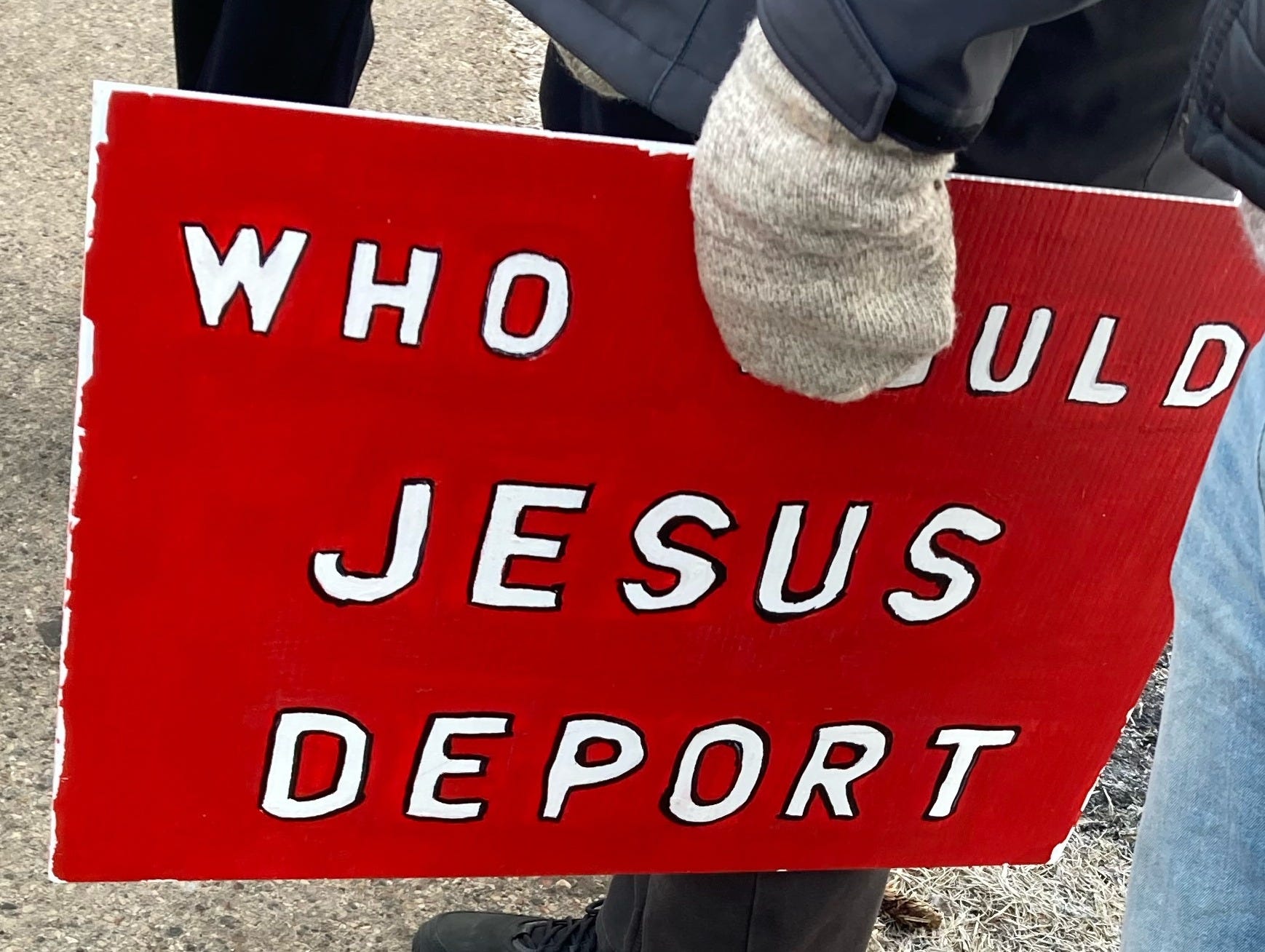
As we prayed the final decade, I watched streams of SUVs and pick-up trucks enter the building’s parking lot. Decades before the Department of Homeland Security was established, the Whipple Building has housed—and continues to—the much more bishop-friendly Department of Veterans Affairs and the Department of Wildlife Management. Some of the cars passing by must have been employees of those departments going into work, I thought. Or they might be attorneys, one of the rosary keepers told us, meeting a client. I wondered who the drivers were who raised a fist in solidarity with the 20-odd volunteers, protestors, and trained observers shouting at them, praying for them and recording them as they completed their morning commute. I wondered what they thought of the overnight “militarization” of their own workplace.
But I was even more curious about the reactions of the drivers who wore ski masks. What was their mental state as they watched old ladies pray for them, as the bearded man in the high-vis jacket volleyed profanities and scolds at them? What sort of armor had they put on their minds, consciences and hearts before this commute? Was this just like a video game to them? Girding for a role-play battle? The ski masks provoked more shouts from the woke farmer, as did tinted windows and cars with missing front license plates. In Minnesota, unlike Pennsylvania and 20 other states, you’re required to have two license plates on your vehicle. A missing plate, an observer told me, was a sign of how sloppy agents were. It was a sign, he claimed, that they had stolen a vehicle and used the two plates on two different cars. I was skeptical. I saw no documented reports of ICE agents stealing cars online, but that does not rule out the possibility of it being true.
While praying, I was reminded of the many Catholics who pray outside of Planned Parenthoods around the country. Around the corner from the Catholic Worker in New York City, Catholics prayed the rosary outside the now-closed Planned Parenthood on Bleecker Street every Saturday. Driving down 2nd Street in Harrisburg recently, I saw a protester with a rosary outside the Planned Parenthood in uptown.
Praying the rosary at the Robbinsdale abortion clinic was a regular Saturday activity at our childhood church growing up. The prayers were said in the hopes of preventing women from going inside, to pray that if they did, they would change their minds, and that the workers working there would realize the evil of their ways and repent (and quit their jobs).
I wondered what it’s like to go to work with protestors outside, asking you to repent. Although I live life constantly on the moral plane, weighing the good and evil of what I do, I recognize that most people do not. They work a job, they get a paycheck, the existential weight of good and evil do not enter the equation.
To have a group of people outside your workplace, praying for the evil you do inside to cease must have a psychic, if not spiritual, effect. People think that what I do is evil, what a thought. My work is worthy of prayerful invocation against it so that it might cease. Am I doing something I could imagine Jesus doing? Who would Jesus deport?
I know that people have disagreed with what I do, think I do a bad job, or dislike me as a person, but never have I seen a group of grandmas outside my workplace, calling me, my work, or my workplace evil.
I felt the same as the leader of the rosary. She said they began praying this rosary five weeks ago. When she began, she was praying for the 3,000 humans who had been or were being held captive in the Whipple Building. But, over the course of the past month, she has begun to pray for their captors.
Partly, I’m sure, this is because of their visibility: you see human faces driving inside; the human inside are invisible in their locked bathrooms. Partly this is because, while it is easy to empathize with the captives, I think it is harder to empathize with the captors: how could you do this? What is motivating you to drive across what is clearly the wrong, immoral, illegal side of the border you have erected? How could you keep a woman locked in a bathroom all day?
“Black people, along with the poor and unborn, were ever but only present in theory, elect in affliction and loved in abstract.”
— Kate Riley, Ruth
Abortion has become an idol to certain Catholics. Something that instantly shuts down the conversation, something that they need to be wrong more than they need God to be good. Abortion has become a weapon of an isolated suburban Catholic to remove themselves from the world while also feeling like they are engaged within it.
At a recent conference on Catholic Social Teaching in our diocese, a political lobbyist spoke about the importance of ending human trafficking, because women who are the victims of human trafficking get abortions. And so to stop human trafficking is clearly part of our mandate to put our Catholic faith in action, because by stopping human trafficking, we stop abortions.
This sort of moralistic algebra is clearly not a part of the body of Catholic Social Teaching, and it’s clearly not Catholic theology, full stop. Not only is this sort of argument an example of utilitarianism, it is also an example of exactly the sort of corruption of human dignity that is the root sin of abortion in the first place. So if we actually cared about what made abortion intrinsically evil, we wouldn’t—ostensibly—make this sort of argument that participated in the same polluted philosophical well.
The innate human dignity of a person—their identity as imago dei, made in the image and likeness of God—means that their being is infinitely valuable in and of itself and infinitely worth our time, effort, and advocacy. This is the sort of mathematics that Catholic Social Teaching is based on, and it certainly does not comparatively value the life of a woman and the life of an unborn baby. It is not so stupid to only care about human life before it has passed through the birth canal. It is not so racist to only care about white women; only care about humans deemed citizens by the nation state; only care about humans with no criminal record. The sort of divine mathematics that equates our worth does not calculate human value the way that the world teaches us to.
These sorts of moral calculations of goodness parsed in terms of per abortions saved were saying the quiet part out loud: we do not care about women, they are not worth our time, our care, they are not persons of moral concern. We only care about ensuring that abortions do not happen.
On Tuesday, Bishop Kevin Rhoades—the former pastor of our parish here in Allison Hill—led a rosary at the Our Lady of Lourdes Grotto at the University of Notre Dame in South Bend, Indiana.
The bishop was on campus celebrating the 5:15 evening Mass at the Basilica, according to The Observer, the student newspaper on campus. According to The Observer, the Mass was a part of a conference on faith and science.
The bishop invited attendees of the Mass to come pray for the sanctity of life at the Grotto after Mass. According to the Observer reporters, he offered no other context.
EWTN News (formerly the Catholic News Agency) offered an interpretation of that requests context in its headline on the story: “Bishop Rhoades leads rosary for Notre Dame’s Catholic identity amid appointment uproar.”
The headline is an example of what my friend Dan calls Asymmetrical context™ The request to come pray at the Grotto in and of itself had nothing to do with the appointment uproar, the context is chosen to suit the editorial slant. However, in this particular case, there is a much stronger case for the inclusion of that particular controversy as context for the bishop’s prayer request.
Rhoades issued a February 11 rebuke of the appointment of Professor Susan Ostermann to direct the Liu Institute for Asian Studies. He cited that she had authored 11 op-eds in the national and campus publications advocating for abortion access, highlighting the positions that he hoped she would retract:
the pro-life position has “its roots in white supremacy and racism,” and has misogyny “embedded” in the movement. She has attacked pregnancy resource centers as deceptive “anti-abortion propaganda sites” that harm women. She also argued that the Catholic social doctrine of “integral human development” supports abortion because it enhances freedom and flourishing for women. These are all outrageous claims that should disqualify her from an administrative and leadership role at a Catholic university.
Two things can be true at once. It can certainly be true that abortion is gravely immoral and that the movement dedicated to ending it is founded in white supremacy and infused with racism and misogyny. There is nothing in any piece of Catholic doctrine that prevents us from engaging with this argument and the evidence it brings forward. In fact, it is our duty to ourselves and our human dignity to think clearly. And thinking clearly would demand that we give these arguments about the movement surrounding the crusade to end abortion some consideration, not to mention engage with reported facts as fact.
Firstly, there is abundant evidence that pregnancy resource centers can in some cases be more like propoganda than support. Not all pregnancy resource centers are alike, some can be excellent and important, some can not. Simply invoking the idea of a “pregnancy resource center” does not instantly inure your operation from all malpractice or sin. In this case, it would be irresponsible to retract a position that can be demonstrably proven true.
Secondly, it does not take much deductive reasoning to conclude that a movement dedicated to forcing women to bear children wanted or unwanted might foment coercive, rapine rhetoric and concupiscene in the men dedicated to it. Not that it must, but that it might. If it is not aware of its own libido dominandi, then it will be more likely to fall prey to it.
Kathleen Bonnette, theologian and programs manager of the Center on Faith and Justice at Georgetown University, wrote about the misogyny of the pro-life movement earlier this year. Clearly, such an argument is befitting of a professor at a Catholic University.
Thirdly, the question about integral human development supporting abortion is clearly contradicted by the body of Catholic Social Teaching, and yet, multiple studies have shown that most Catholics believe that abortion is not a social good, but that it is necessary to keep legal in some cases, such as to protect the life of the mother or in the case of rape or incest. This is a situation in which the majority of Catholics’ belief mostly reflects the teaching of the Church.
Yes, the Church teaches that abortion is always wrong. But medical interventions to save the life of the mother are permissible in Catholic moral theology, even if an unintended side effect is the death of her child in utereo. In cases of rape, Catholic hospitals are allowed to administer emergency contraception to victims to prevent fertilization and “protect them from an attacker’s sperm.” In common English, this is called “abortion access.” In Catholic theological discussion, the moral delineations and the motives of the specific actions are more precise. But this might be an instance where common concern for the development of women could lead to dialogue and the seeking of common ground in opposing worldviews rather than condemnation of a less morally nuanced position than the Church’s own. Lack of interest in having this dialogue offers support for the above point that the anti-abortion movement is misogynist and not interested in the welfare of women.
Finally, the assertion that the anti-abortion movement has its roots in white supremacy is simply an historical fact. It does not mean it has to continue in this fallacy, but how will it ever repent when it refuses to acknolwedge that the political coalition that sucked Catholics into the anti-abortion movement were pro-segregation, anti-Civil Rights and highly racist?
I know nothing of this professor. Perhaps she is truly as anti-Catholic and problematic as the campaign against her suggests. But the arguments that Bishop Rhoads cited in his statement do not, on face value, disqualify her from teaching at a Catholic university. The campaign against her undercuts its own righteousness by trotting out reasons for her dismissal that do not address matters of faith and morals but instead quibble with differences in politics and persuasion.
The consistent ethic of life that the Catholic Church actually teaches demands that we care about racism, we care about immigration, that we care about humans on both sides of whatever state-sanctioned border is erected between the worthy and unworthy. This truth is so self-obvious to the Christian, so blatantly foundational, that the fact that it is not screamed from the rooftops by bishops should make us perhaps march outside their workplaces with rosaries.
The rosary Bishop Rhoades prayed at the Grotto could have been, like the rosary outside Whipple Building, a prayer for the sanctity of life, no matter the border: the uterine wall or the Mexico frontera. It could have been, like the leader of the Whipple Rosary’s was, for the souls of those who do violence to their neighbor, not knowing what they do, and for the precious images of God shackled by their ankles in a bathroom. How can we be so blinded by abortion mathematics to not care about the Muslim woman shackled by her ankles because she has no unborn child we need to ensure enters the world? How can we have become so enthralled by the idol of abortion that we have neglected to care for the world the child enters into?
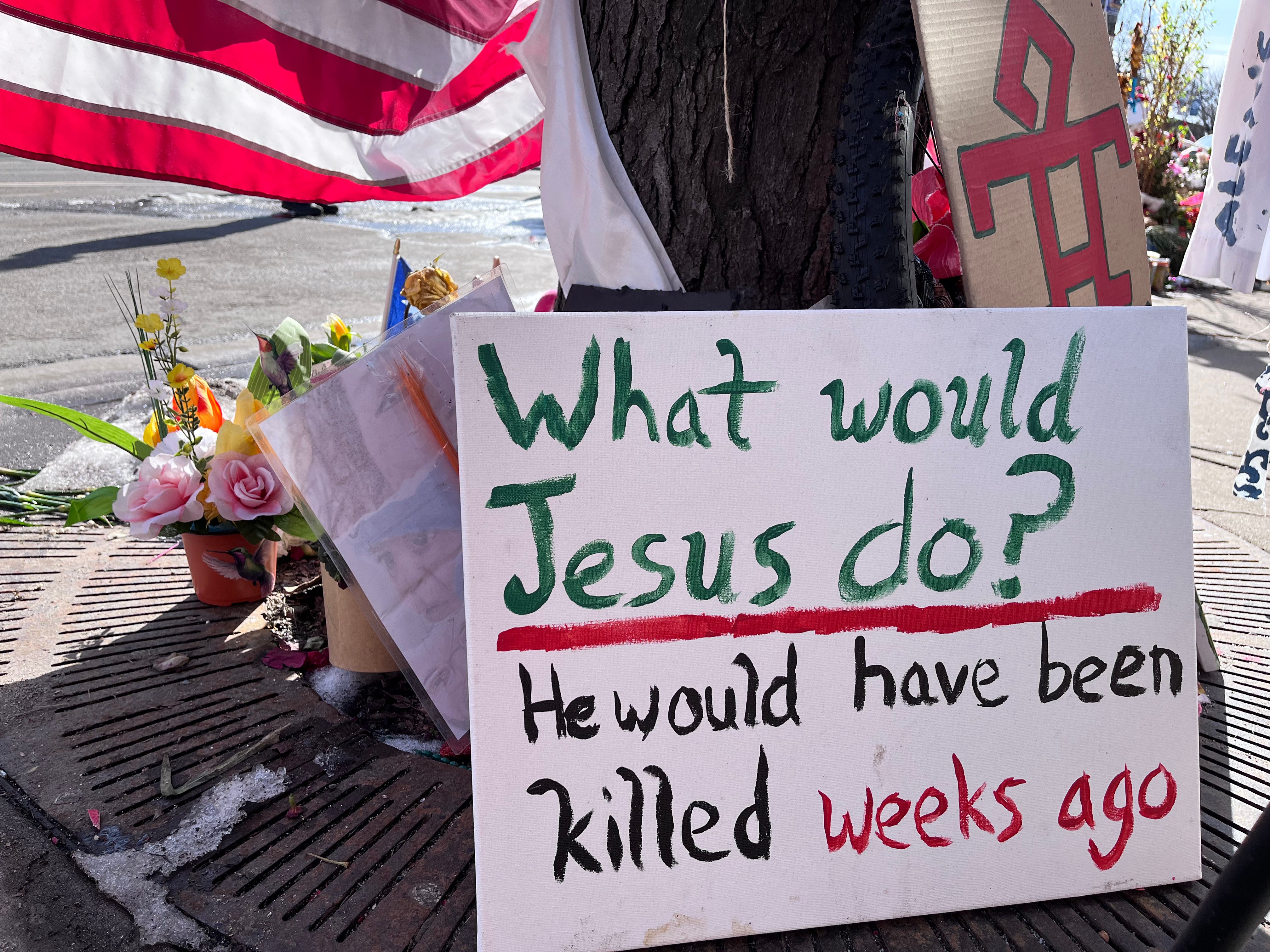
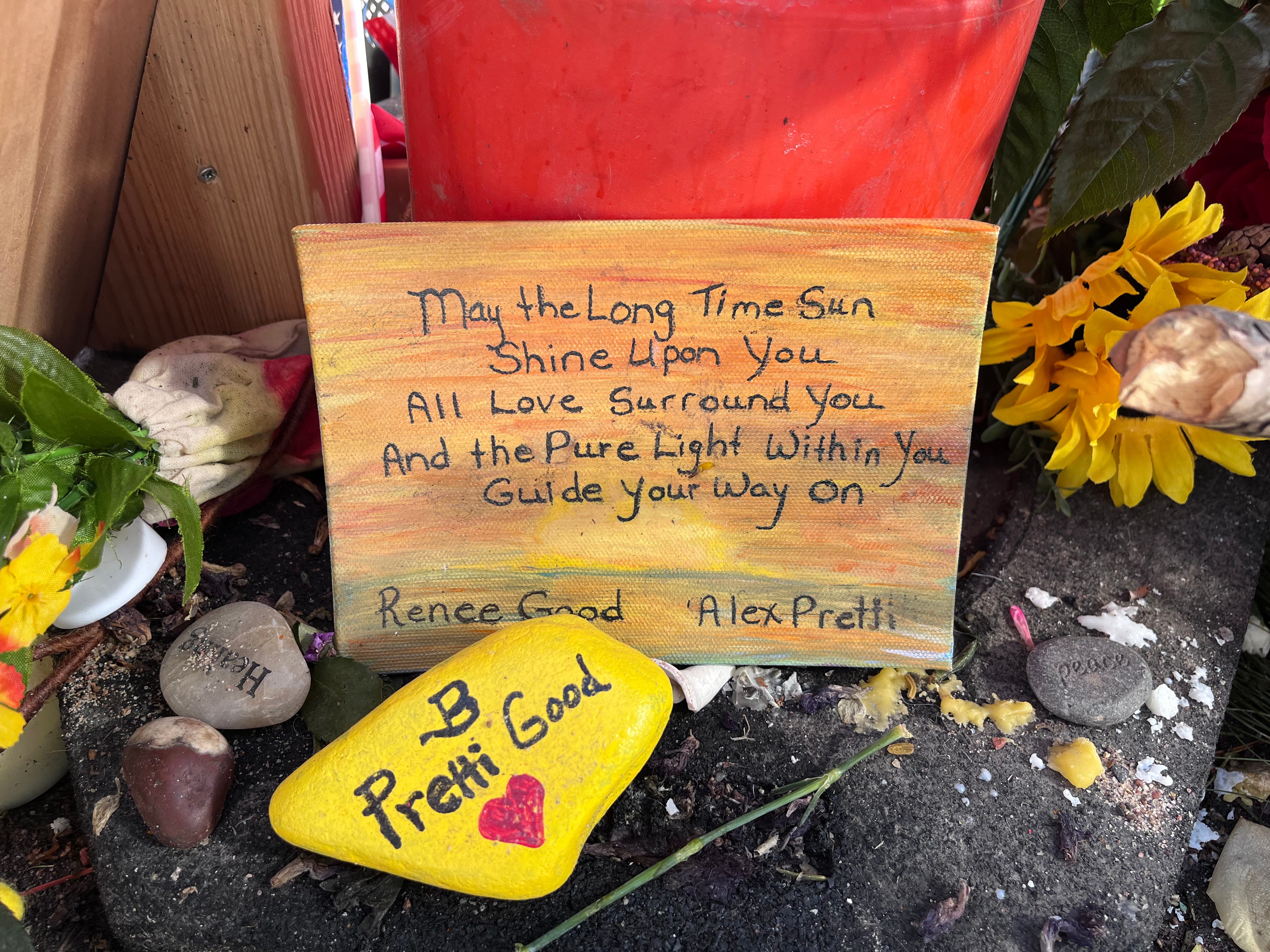
After the rosary, we visited Alex Pretti’s memorial on Nicollet Avenue and 26th, across the street from Glam Doll Donuts in South Minneapolis. It reminded me of visiting George Floyd Square five years ago. We visited the square a year and a half after his murder, a year and a half after an uprising dangled the promise of some kind of accountability for the racism of our past, some kind of atonement for the blood of the Dakota prisoners, the deaths of immigrants, George Floyd.
At Alex’s site, the air was raw with grief. Only one month ago, Nicollet Avenue was filled with federal agents. Only one month ago, this man was killed for no reason, caring for his neighbor. “Any righteous person would have done the same” said the banner above the spot where Alex Pretti breathed his last.
Catholicism’s foundational truth is that God became human. God entered into human history. There is no engagement with that God unless we understand ourselves as within history.
Each of our choices takes place on this moral plane, on the plane of our shared human history, a history we call political. We cannot understand Jesus without understanding his incarnation as what Pope Benedict XVI called his arrival into history. We do not live in Fukuyama’s end of history.
We have not come into being in late capitalist America, fashioned out of some primordial goo of normalcy, where there is an amoral and apolitical reality that we naturally participate in, or an historical reality we can choose to participate in or learn about but does not shape our lives. We live a historical faith, one that God has a vested interest in, one that God has hopes and dreams for. We cannot make sense of this faith without understanding ourselves in history, as actors in a drama. Our parts are open to us—we may be anything we please, as John Steinbeck writes in East of Eden—will we have the courage to be the righteous? There are no easy truths or cheap grace for the righteous. There can often be a great price to pay.
On the spot where Alex Pretti died, I prayed for the courage that he had; for the daily practice of love of neighbor, of small saintly selflessness that gave him the power to be righteous when the moment called for it. When history came to his doorstep, he chose to cross the border between himself and the neighbor the state had decided was disposable. What would Jesus do? He would have been killed weeks ago.
That last line 🔥
signs of growth and refinement, and the writer's voice coming of age, where the age is said to be begging