

cash infusion
On how the beggar and Burberry have the exact same view of what a coat is

Originally printed in Jan-Feb issue of The Personalist from St. Martin de Porres House
Charity works the way the wealthy think it does if you are helping someone who is a part of the same market as you—you give them a windfall, a trickle-down from a higher rung on the ladder. But, stick around a house of hospitality or soup kitchen long enough and you begin to see the rhythms and exchanges of a different economy.
Last week, for example, James gave a woman a coat. We had a bunch of new coats donated from Saint Catherine Labouré church down the road, so it was no skin off our back (or coat off our back, as it were). There was an abundance of new coats—Donna Karan New York, you know the thing: top-shelf Kohl’s ware. So we were happy to help her find a coat that fits and, a great bonus, looks good.
In the intervening days since, James noticed, not once had he seen her with the coat. It was not a particularly warm stretch of days; it seemed like it would have been a day in which you would have worn a coat when you needed it. It seemed like a day to be wearing a coat if you had one, and we knew that she had one.
Who knows where the coat is, and who particularly cares—we are the coat givers, not the coat policers—but it made me think about charity. It made me think about what it meant to give a coat that was not received as a coat, but as something else.
The rich want to give charity to the poor. The logic goes something like: I have a lot, you have a little, so let me give you some of my excess. I have five coats, you have none, I will give you a coat. That’s charity. At least, from the perspective of the giver.
But, really, we ought to think about charitable giving as an infusion of capital into an economy that is capital-starved. Charitable giving is when the rich—those who are part of the financial markets that generate the seemingly fathomless wealth that led to the millionaire population of the United States exploding from 11,000 to 24 million over the past century—come in contact with the market economies of poverty.
In impoverished markets, labor cannot be exchanged for wages, the way that our typical capitalist exchange functions. Capital-starved markets demand that more in-kind exchanges take place. In this economy, anything is up for re-sale. Shampoo bottles, shoes, soda cans. In a capital-starved market, these goods become capital gains.
But the truth is that the poorest of the poor are not participating in the same economy as the rest of us. Immigrants have their own economy. When I see the Haitian mothers and grandmothers walk the streets daily, with their reusable bags flapping, looking in recycling bins and trash cans, combing through the free goods on the bench, I know they are looking for capital. When immigrant mothers walk the streets daily, with their reusable bags flapping, looking in recycling bins and trash cans for free goods, I now see they are looking for capital. When we hand out shoes or socks or coats or cans of food, we are really infusing capital into an economy that is capital-starved. Sometimes (not always, but sometimes) in-kind donations we give out: new coats, deodorant, nice shoes, function less as the items themselves, but as an exchangeable commodity that has a negotiable value.
I have heard stewards of food pantries, managers of charitable warehouses and keepers of clothing closets complain about this phenomenon. I remember looking over the pathetic shelves of canned goods and wondering why this lady begrudged anyone selling them, if they were forced to do such a thing. I thought of all the pathetic detritus of living I have posted on Craigslist myself when moving apartments. Did I really need that $20 or could I have left it on the curb for free?
We have been so formed by our economic system to believe in scarcity. We believe that there is not enough to go around, and it seems unfair for people to see the small goods being offered out of a generous abundance (the logic of gift) as something that will be reduced to its monetary value (the logic of exchange). It seems “unfair” to sell what someone received for free. We forget our sense of scarcity is highly manufactured.
And, we forget that the items we have purchased for what they are in their substance and form—beds, coats, clothing—are also only valued as bearers of a fluctuating price by their makers.
In Chile’s Atacama Desert, clothing that manufacturers have exported blows around in the arid winds. Estimates say there are nearly 60,000 tons of clothing discarded in the desert, much of it with the tags still on. This is far from the only “garbage mountain” of clothes polluting the earth, a sign of the wastefulness of our industrial system. In 2018, the luxury manufacturer Burberry came under fire when the BBC reported it had burned coats, clothes, and purses over the past five years to ensure its upmarket luxury brand remained exclusive. The estimated value of the destroyed merchandise was 90 million UK pounds, equivalent to roughly $120 million.
In the logic of our capitalist industrial system, excess value should be destroyed, not given away. Because the price of the thing matters more than its inherent worth or beauty. When we collect items to “give away” to the poor, we are thinking in deep human logic: what are the necessities I need to survive? We are thinking in the logic of mutual aid. And, of course, this is often the spirit in which the goods are received, absolutely. But when the goods are received with an eye toward their re-sale value, that is, in fact, the entrepeneurial spirit that has built fortune 500 companies, formed our multinational commerce system, and set fire to goods we are told are precious and expensive.
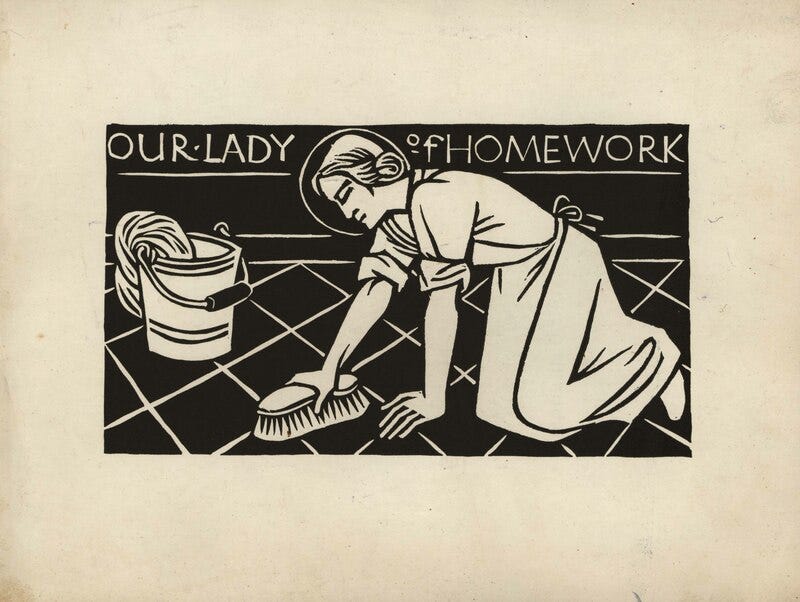
Ade Bethune, an artist of the Catholic Worker movement and a student of Peter Maurin’s, wrote about the dignity of work and manufacture in a small pamphlet entitled “Work.”
Ade Bethune, an artist of the Catholic Worker movement and a student of Peter Maurin’s, wrote about the dignity of work and manufacture in a small pamphlet entitled “Work.” Bethune described her philosophy of labor: work, to Bethune, was a way of imitating God. Just as a worker chops wood, scrubs floors, washes dishes, or makes something, so God makes the person out of the raw material of creation. This vision of work as manual labor, as a handicraft, was in direct opposition to the mechanized forms of labor developed in the industrial revolution and that have been galvanized in the iPhone age. Bethune argued that we had to know our raw materials in order to make something good and beautiful with them.
In the same way, God knows and loves us, the divine material of creation. Love is at the heart of what Bethune defines as “good work.” When “we work lovingly and well (regardless of the importance or smallness of the work) we have chosen to work well,” she writes. Labor is a gift, not a commodity,” Peter Maurin, Ade Bethune’s teacher, said. “Labor is a means of self-expression, the worker’s gift to the common good.”
Most readers—particularly if you were raised a middle-class American—have been taught from a young age that there is only one possible form of a market—exchanging our labor for wages. We have not questioned the downstream effects of that market—everything is valued with a pricetag; excess product can be destroyed to keep prices up. But the Catholic Worker’s founders believed in a different kind of market, a different kind of economy. Economics comes from the Greek word oikonomia, meaning household management. Our households can be managed differently than viewing everything we do and make as simply a commodity to be sold for wages.
If you have been tempted to complain about a donation being sold for money or a few food pantry cans parlayed into legal tender that can pay a family’s rent, I invite you to ask yourself the questions I challenge myself with in those moments: What do I commoditize? What markets do I participate in that my neighbor might not have access to? Do I treat my labor as an act of love for the common good, or is it a commodity, sold to the highest bidder?
Ultimately, Ade Bethune and Peter Maurin believed that our labor was our human vocation of sanctification, of integrating the holy into the ordinary. The Catholic Worker believed that we could reconstruct the social order, make a more just world that mirrored the justice of heaven, by embarking on this sanctification of labor, this drawing out the holy in our ordinary days.

“She stood in sub-zero temperatures with a sign. This is the diaconal church” by Casey Stanton at The Witness
My friend Casey Stanton at Discerning Deacons wrote a short editorial about one of Discerning Deacons’ staff members, Lisa Amman, who participated in protests against ICE in the Twin Cities. Casey writes about how Lisa’s witness is a demonstration of what the diaconate is (in a lot of debates and confusion about what it means), of what a synodal chuch is (walking with one another, concretely, physically) and what a missionary church is (the vocation that our two missionary popes have been calling us to for the past decade and counting!)
When I look at what is happening in our country — and in Minnesota, where Discerning Deacons was launched almost 5 years ago, and where Lisa recently stood among tens of thousands in sub-zero temperatures to offer public witness in the face of violence and evil — I am reminded that a “constitutively diaconal Church” is not a theory. I found myself wishing she could have been there in a deacon’s stole. But she was there with a simple sign: Jesus calls us to welcome the stranger.
She is not waiting for ordination to live the call to diakonia. The diaconal Church goes forth to love and serve. It listens to those seeking bread, belonging, and hope. It takes material and spiritual needs seriously enough to respond — not with vague compassion, but with what St. John Paul II called a “firm and persevering determination” for the common good.
Read Casey’s letter at Discerning Deacons.
“Isomorphism and Uplift: The Ignatian Imagination of Poet Peter O’Leary” by Ryan Carroll at Jesuit Media Lab
My friend Ryan Carroll says that if you meet poet Peter O’Leary in the wild, he recommends holding a conversation for as long as you can. He describes their conversation as a trip to the edges of the cosmos and back, which is what you could easily call a conversation with Ryan himself, who, if you met in the wild, you could carry on for a while about Victorian literature, pesto, birds, Heidegger, and more.
Cherubim: angels. Phanophagous: a coinage of O’Leary’s, its Greek roots (phano- and phage)combining to mean “light-eating.”
These light-eating angels, it suddenly struck me, are human eyes, which take in light, transmit it upside-down to the brain (like “scissoring flame”), which, in turn, flips it right-side up and grasps that data together to create, so to speak, the world we perceive. And through that world, we feel the warmth of divine love.
This divinity suffuses the entirety of “Phosphorescence of Thought” and the entirety of O’Leary’s catalogue.
It closely echoes Ignatius’ suggestion, in the “Principle and Foundation” of the “Spiritual Exercises,” that all of creation is made to reverence and cherish and sing the praise of the divine. And when you read O’Leary’s poetry, you’re thrown into a cacophony of praise — a celestial song in the spin of atoms and the flight of birds and the movements of planets and the love of human beings.
Read at Jesuit Media Lab.
Praying with the Psalms, by Emily Mentock, Ave Maria Press
If you’re looking for a Lenten devotional for 2026, I recommend Emily’s Lenten devotional from Ave Maria Press of three-minute daily prayers with the psalms. Emily is one of the most conscientious and prayerful collaborators I’ve had the privilege of collaborating with, from collaborative reporting at FemCatholic to documentary research at Digital Continent. Emily’s devotional presents the Psalms as deeply human accompaniments to our daily lives. Treat yourself to her insights this Lent. It’ll be a gift. Order here.