

feline epistemology
do not think to turn

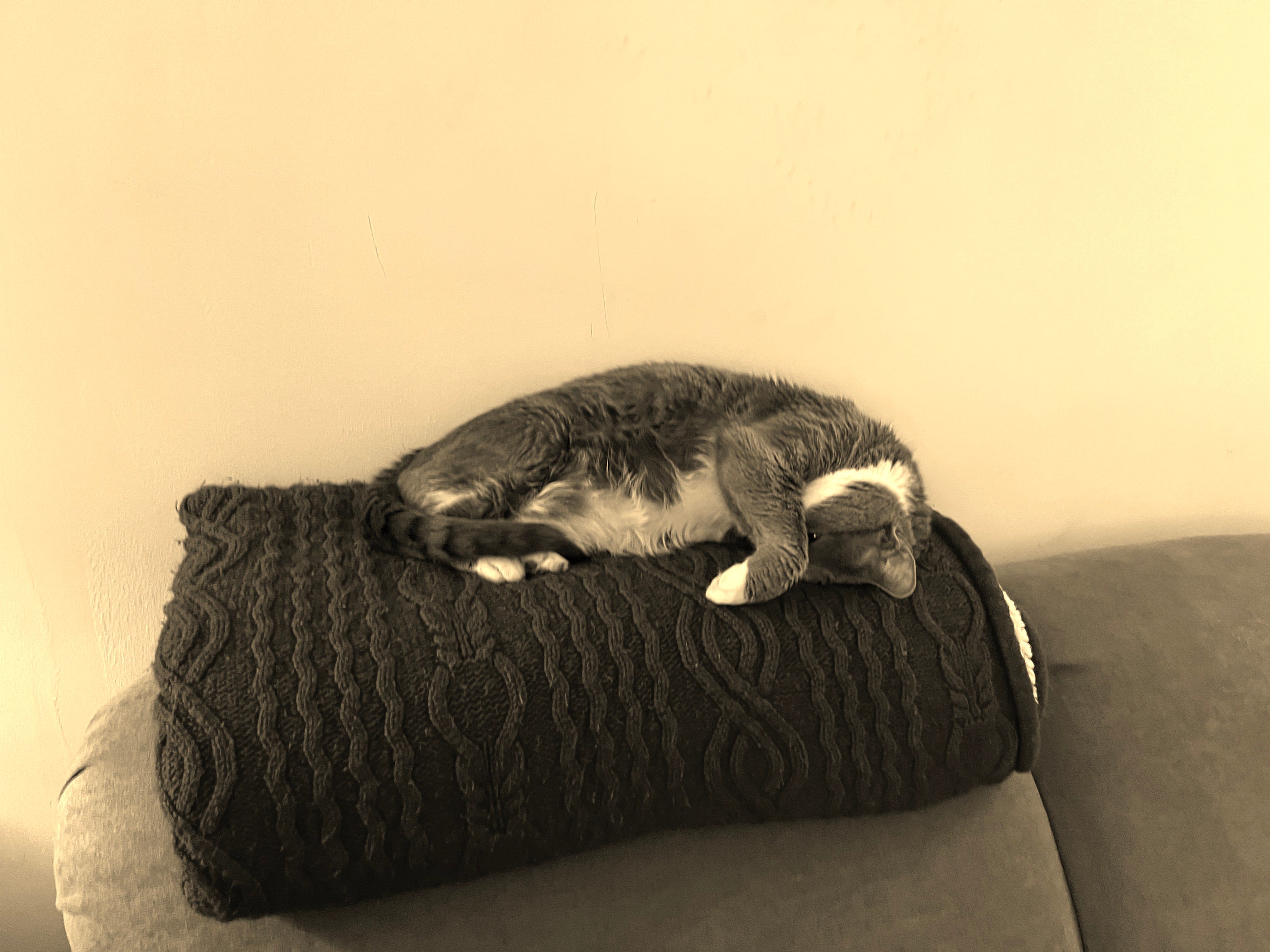
sitting in the guest bedroom,
with our coffees
the 90 degree-streak finally broken,
into something crisper, lighter, a weather that will not wear you out
in front of us, the cat sits with her paw out the window,
and she turns back to look at us her face creased shut in a smile of contentment, watching us through tiny slits for eyes.
she is a pool of grey-furred stillness whose mind is never filled, I don’t think,
with either the sublime or the mundane,
which tumble on a spin cycle in my mind
am i really ready to have children?
i need to order cat food
i saw an editor position with a salary above $100,000. to be perfectly honest with you—don’t laugh—I cannot imagine having $100,000.
having negative 60 dollars in my bank account is closer to having $100,000 than not, especially with the SpaceX ipo. From the mountain top of a trillionaire, ye six figure editors might as well have all the riches of a cat.
how can I feel sexy with no air conditioning?
did a Pulitzer Prize winner commit fraud?
how to solve a problem like freeing a man from ICE detention?
i need lemongrass to make a swarm attractant for the empty hive.
are we born with dinner time, do we achieve dinner time, or is dinner time thrust upon us? How did something so rooted in the fabric of childhood universes become so unachievable as an adult?
my cat just sits, she turns, watching the flies on the hot tar roof, ears airplane-ing open as the birds swoop by, stalking squirrels chasing one another across the tree limbs in need of trimming.
She is on the bedside table, one paw over the edge of the windowsill—insurance that her strange and lanky house companions will not shut it before she wills—
she turns,
neck craning over her furry shoulder, she looks back at us, sipping our coffee, full of fretting, full of sorrow, full of pains of the past and fears for the future, and she smiles,
eyes sealed shut in two happy slits.
All she knows is:
we are here,
with her,
breathing softly in the same room,
beholding the same view from the same window frame—bees awakening in the garden—and she turns.
Sweet Unrest in the Streets
—Sweet Unrest writing out in the world—
“Biblical literacy is more than just knowing scripture stories,” U.S. Catholic
This was a very fun piece to report—the assignment came out of a scripture reflection I did for U.S. Catholic last summer—I love when articulating an idea generates other ideas! And an edifying piece—I learned a lot from the scripture scholars I spoke to for the article.
“In our current context, the Bible is misused so often in so many ways,” says Rhonda Miska, the founder of Catholic Women’s Preaching Circle. “If someone is quoting the Bible and using Christian language and Christian imagery, but what they’re saying or doing doesn’t match the dignity of the human person and the preferential option for the poor,” then, she says, that should raise red flags. She adds that a good test for interpreting scripture is: Does this make me more loving?
Mr. Brown’s Bylines
“Brown, who is always one’s friend in a disaster, applied a leech to the eyelid, and there is no inflammation this morning though the ball hit me on the sight.” to George & Georgiana Keats, May 1819
—Pieces from good friends, and from writers whose words have been a friend to me—
“Pope Leo vs. the Americanists,” Commonweal, David Gibson
The current essay of the month at the Catholic Worker house in Harrisburg is David Gibson’s fabulous articulation of the Americanism heresy for the second Pope Leo who has encountered it. David, a veteran of hierarchical reporting, has touched on a theme that manifested at the U.S. Bishops’ June meeting in Orlando. There, they emphasized in a plenary session that Catholic engagement in politics needs to be reframed so that politics are viewed through the lens of faith, rather than— as they diagnose is frequently the case—faith being molded to fit a political party’s platform. For those of us who live under the banner of Dorothy Day (an embracer of the epithet “unAmerican”—“we are unamerican, we are Catholic,” she once wrote), this essay arrives none too soon.
If Leo XIII was wrong about what would corrode the religious identity of Catholics back then, it turns out he was right to worry about American Catholic identity; he was just a century ahead of his time. The recent clashes between Pope Leo XIV—who took that name to signal his commitment to advancing the previous Leo’s better-known teachings on social justice—and the Trump administration have underscored how U.S. Catholics have come to behave as though they are religious authorities unto themselves.
Read the full essay here.