

magdalene memories
Set up signposts, Make landmarks; Set your heart toward the highway, The way in which you went. Turn back, O virgin of Israel, Turn back to these your cities. Jeremiah 31

When we got off the bus in Magdala, my heart sank.
The first time I had come to Magdala, I had arrived in a bit more style, steering my white Toyota Corolla rental into the dusty parking lot.
I arrived at the parking lot from the guest house of a sweet gay Israeli couple, several miles south.
In a diary entry from that summer, I described my living situation in typically over-written prose:
My Airbnb is a little guesthouse behind the main house of a charming little family of shy children, a friendly host (I haven't met his partner) a bunch of cats, and two old and kind-looking dogs. It's nothing fancy, but it's a lot of space and it's comfortable, and although there could be a few more windows, in my opinion, I do have a lot of privacy, which, as a young woman traveling alone, is invaluable.
Back then, in the summer of 2017, I was, as the kids say, a nothing-knower. The Israeli military base up the hill, the sound of military drills and 18-year-olds in army fatigues laughing at sunset did not indicate anything about the story of Ilaniya, the little village where I was staying.
Ilaniya was certainly the minimum viable product of what can be labeled a village: Ilaniya was a few houses along a path that, if you followed, led to an idyllic grove of olive trees. As my aside about a young lady’s privacy could tell you: I was a timid traveler. I still had no conception of what safe or unsafe meant. After nightfall, in the guest house, I was so terrified that I routinely barred the front and back doors with the kitchen chairs. I couldn’t tell you what the threat was that I thought was out there. What was I so afraid of? Perhaps the coyote that I saw, darting across the main road. Fundamentally, my fear came from the ignorance: I had no idea where I was.
Ilaniya was formerly known by the name Sejera, a reference to its neighboring Palestinian village of Al-Shajara, a community which had been farming the lower Galilee since the Ottoman period, at least. After the Nakba, when the Israeli army systemically slaughtered or evicted at least 750,000 Palestinians from their homes in 1948, Ilaniya slowly incorporated Al-Shajara’s lands into its own.
When you realize you’ve been sleeping on stolen ground, the hairs on your neck stand up like needles, a feeling like when Jill realizes they’ve been eating a talking animal in The Silver Chair. Ignorance, in the rear-view mirror, seems so impossible. How was there a time I did not know what the Nakba was? When I had no sense of the stories underneath the layers of sweet-smelling straw on the road? When the peace of a quiet summer night brought me to terror?
Every night before the sky grew dark in Ilaniya, I walked down the path to the olive grove. Olive trees lives for 500 years on average. How much of the story do they remember, I wonder, how much history is held in their branches, swaying in the gentle evening wind.
But, six years later, I was not staying in Illaniya.
James and I had woken up that morning in a hotel in Nazareth, deep in the old city, up winding steps from the Basilica of the Annunciation. The streets were painted with graffiti about land, occupation, olive branches and doves, reminding me that Palestine was Palestinian. Winding labyrinths of snugly-coiled streets and alleys advertised that this neighborhood was built before cars or horses; calligraphied houses blossomed out of flagstone streets designed for handcarts and humans. In Nazareth, I was surrounded by shorthand of a story I had already memorized; signposts of a route I knew how to walk. In Nazareth, the blank slate of Illanyia was nowhere to be seen; in Illanyia, Palestine was buried under the olive trees.
The halcyon days of rental cars and roses were long behind me at this point. Instead of speeding down highways carved through ancient villages and sheep pastures in the white Toyota Corolla, James and I were on the bus. We stumbled to the bus stop at dawn and caught the 431 from Nazareth to Tiberias, and from Tiberias, another bus to Magdala.
Six years before, Magdala had been a mystical experience for me. The dusty parking lot led to excavations that Franciscans had begun in the 1970s, uncovering a Byzantine church; further excavations in the twenty-first century revealed two synagogues dating back to the Second Temple period. One of these, perhaps, is where the town’s most famous daughter would have prayed.
I remember walking through the excavations, covered in open-sided tents, with the innocent absorption of a nothing-knower. When I remember how I traveled then, I feel like a child: I soaked up the sense of awe that all that ancient history kicked up, but I did not ask any questions about it. In some sense, it was a waste. To see and know not what you see? Where’s the wisdom in that? In another sense, being there was irreplaceable. To be somewhere, your body a signpost in its history, is to know a story about it that no one will ever be able to erase from your memory. It burrows deep beneath the surface and waits for excavation.
And so it is only because I had walked through the dusty, open excavations of Magdala six years before, the morning sun sparkling off the Sea of Galilee in the background, and into Magdala’s church, where large frescos celebrated the many different miracles of Jesus, that I knew with certainty that the monstrous hotel that the Legionnaires of Christ had built in front of the excavations was an abomination.
The Legionnaires of Christ bought the property in the early 2000s from a Jewish-Israeli private investor. Too much of the beachfront along the Sea of Galilee has been developed into resort compounds; I’m sure a similar fate was awaiting Magdala, except that tourism dried up during the Second Intifada. So the investor sold it to the priests. A correspondent from the Times of Israel visited Magdala a year after me and was pretty unsettled by the experience, not-so-subtly accusing it of proselytizing Jewish Israelis. She cast a side-eye at the calls for donations to the multi-million-dollar capital campaign funding the growing visitors’ center complex. I had to agree with her there.
When I first arrived at Magdala, in 2017, I was walking the Jesus Trail to Capernaum. The Jesus Trail, created in 2007, was then a decade old. The trail runs through Galilee, from Nazareth to Capernaum, but I was hiking just the final leg that day–in fact, I was going to Capernaum and back in one big push. It was an ambitious and foolhardy plan, which is how travel has always gone for me, despite my best adult intentions to pace myself.
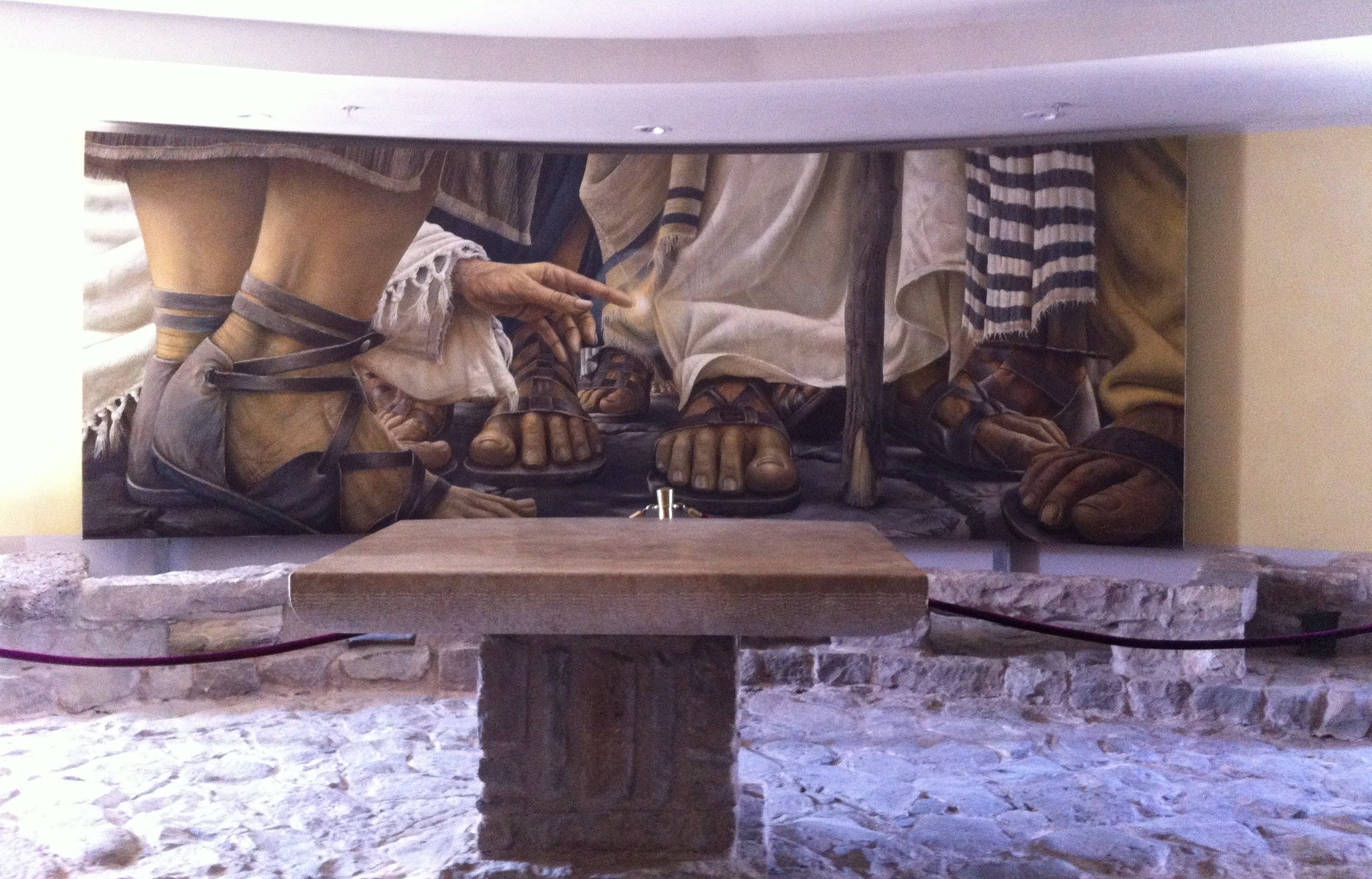
My first experience of Magdala was simple. It was quiet. I walked into the church, called “Duc in Altum,” and the sea glistened like the Son of Man mid-transfiguration outside the large windows. Behind the simple stone altar, a large fresco depicted the woman with the flow of blood touching the hem of Christ’s garment. I had never seen that depicted in a church before, much less as an altarpiece. How many other moments of women in the Gospels are missing from the familiar iconography? What would our faith look like if we imagined them more frequently? What better place than Magdala to ask that question?
The Holy Land is holy, this I believe with all the faith of a nothing-knower. The technicality of its sanctity remains a mystery to me, but many people believe that its sacredness is a variety of the holiness of any place where love has touched us or grace has changed our lives. The stories that took place along this lakeshore long ago are the stories that shape our own. They are our signposts. Walking there, it’s hard not to feel the weight of all the many pilgrims who have walked there and the faith their footprints have sown into the fertile soil. It’s hard not to believe that their weight is sacred. Some people believe that the holiness comes from that collective weight of humans seeking the divine. As though all those footprints, over the years, wear down the wall between heaven and earth, tear through the thin veil between the human an divine.
So I walked the Jesus Trail out of the mystical dust of Magdala, folloing the pebbly harp-shaped shore of Lake Kinneret, up through a kibbutz where a first-century ship called “Peter’s Ship” had been dredged up from the Sea of Galilee and put on display in the kibbutz’s community center; I hiked through beaches, where I took off my shoes and dipped them in the lake, felt fish nibble at my toes. I hiked through groves of trees where parakeets flew above my head. I hiked up a hillside of sun-scorched grasses, past a pace of donkeys, I saw the church where Christ appeared to Peter after the Resurrection, its black basalt fading into the black pebbles on the seashore; I walked into Tabgha and saw the mosaic of the fish and loaves that has become the Mona Lisa of Holy Land pilgrimage art. I achieved Capernaum by lunch, barely glancing at its basalt ruins lying like a black bruise on the north shore of the sea, before starting back again.
I don’t remember much of the hike back. But I remember making it back to Magdala, stopping at a small shop and buying a Dove Magnum bar–maybe even two. I think I lived mostly on ice cream bars in Galilee. The thing about living in the country and getting around by car is that you don’t have the resources of a city around you, within walking distance. There were no restaurants in Ilaniya, just the olive groves.
So I would arrive at the guest house each night after hiking under the hot sun, smelling of suntan and windburn, with my stomach rumbling. I would put my chairs in front of the doors and eat small handfuls of pistachios and cashews as I wrote until I slept.
When James and I returned to walk this same stretch of the Jesus Trail, old memories arose, rearranged themselves–some of them were revised with the facts at hand, others I buried again, hoping to preserve them from the onslaught of history around us.
As we hiked, I made a catalogue of changes. I did not, for instance, remember the trail leading us through so many resorts. We stepped over nude bathers in the tree-lined shallows of the shore. I didn’t recall that Peter’s Boat had been behind a glass-doored gallery that charged admission. I did not remember a certain detour we made around an Israeli military facility on the lakefront. In some ways, walking the Jesus Trail in 2023 was a catalogue of loss; rosary recited for all the reeds and marshes filled in with steel and concrete. Even if this land is holy, how can we see it under all our plastic? I muttered.
I submerged my memories of what the trail had been before back into the ocean of memory. I hoped that I could draw them out, later, signposts of an intact past for future pilgrims to decipher. But our walk also generated new memories. Rather than pushing on and on, a marathoner of one, traveling two-by-two offers a different pace, a new way of wayfinding.
My mental catalogue included a few new memories I hadn’t noticed before. We stopped at a stone marker noting the spot where the woman with the flow of blood was healed (Mark 5). We could not enter the church to see the fresco at Magdala, but wasn’t this better? Here, on the road, a sign that said: this happened here. Right there, under your feet. I took a picture of James with it, since his summer Bible study had just read Mark’s pericope. At the Primacy of Peter church, I noticed the altar that the fourth-century pilgrim Egeria had kissed. I picked up a handful of rocks on the shore of the Sea to give to John, one of the members of the Bible Study, who was currently sleeping on our church steps.
In Capernaum, we went into the excavated synagogue and read John 6: the Bread of Life discourses that Jesus had originally declaimed at the synagogue at Capernaum, which had won him few friends. The hair on our necks stood on end like iron filings at True North. These words are read in churches around the world, but they were born here. Despite our English, these words belonged.
In my diary from six years before, I had noticed, “There are a lot of hitchhikers in Galilee, a surprising number, in fact.” Even a nothing-knower can perceive a thing or two.
Before James and I had left Jerusalem for Nazareth, Marie-Farouza had told us: You have to hitchhike around Galilee. I would be surprised if this French-Egyptian sister reached five feet, but she assured me she felt perfectly safe hitchhiking in the Galilee. Hitchhiking is part of the culture, extremely common, safe, she said. She knew where she was.
In Capernaum, we struck up a conversation with a German-South African man who was visiting the archeological site on a lunch break. He worked for a European chocolatier who had a food production factory in the Upper Galilee, near Safed. We copped a ride up to the top of the Mount of Beatitudes, a few yards back, rising over Tabgha, a perfect view over the lake.
The Mount of Beatitudes had originally been considered as a location for Tantur Ecumenical Center, which I was researching in Jerusalem that summer. The views could not be more different, I thought, walking around the terrace of the Church of the Beatitudes. A bowl of glass, with waves lapping on the shores, rippled out before us. Tantur, on the other hand, overlooks a scar: the separation wall with its military towers, separating Bethlehem families from the olive trees running down into the valley. The view from Tantur is beautiful, is holy—it is also painful. But, on the Mount of Beatitudes, the pain seemed far away. Blessed are the peacemakers, the palm trees sighed in the evening wind rising off the lake.
We hiked back down the mountain through groves of banana trees, covered in netting to protect them from the sun. Where the netting had been torn, the trees were burnt like they had been scorched by brimstone.
At the foot of the mountain, we waited at the bus stop for the last bus back to Tiberias before Shabbat. As cars sped by in quick succession, but no bus appeared, we slowly realized that we had come too late. There was nothing to do but stick our thumbs out, confidently, pleading for someone to stop. I tried to look pleasant, unthreatening, but not like easy prey.
Eventually, a pick-up truck stopped. A tanned kite-surfer invited us in. We had spotted kite-surfers earlier on the lake—he must be one of them, we said. Unlike the kind couple in Ilaniya, he spoke absolutely no English, so I pulled out my feeble Hebrew. We tried to communicate and mostly failed, but he took us as far as the intersection closest to the village that was his destination. The next guy who picked us up was a calm yeshiva student on his way to Shabbat services in Tiberias. He spoke marginally more English, but our conversation found its limit pretty quickly. Thankfully, the plight of hitchhikers is universally comprehensible, and hospitality is the Middle East’s lingua franca.
Forking over the money for a taxi from Tiberias to Nazareth, we arrived back at the Old City in the lamplit blue night. As we walked back to our hotel, there were no signs in Hebrew.
Our pilgrimage to ancient sites from scripture, churches crafted from millennia of devotion, had been a walk through memories that weren’t so much contested as siloed, sealed off from one another; each olive tree or ancient stone was a signpost marked with contradictory directions.
But our bodies had walked through all these places. Somehow, they had seen them all. Those stories, sealed off from one another, we had walked through the locked doors. Memory is faulty—just try remembering the year 2020 chronologically—and it is manipulated by large forces that often want us to forget.
They want us to forget the reeds that waved in the wind before there was concrete filling in the marshland. They want us to forget the olive trees, whose wood resists rot. They often want our bodies gone: disappeared or destroyed, because the body remembers. Bodies are the signposts for the mind’s eye: we know things once were different, because we went there and we touched them with our fingertips, we smelled the straw and felt the weight of our footprint on the path. Bodies do not forget as easily as we do.
Travel is a fool’s privilege, perhaps—but even a fool can hold onto a memory. Once you have a memory, you have something precious: a bit of common past that can’t be erased.
So don’t believe everything they tell you, I suppose. Go see it for yourself, if you can, if you’re lucky enough to see. Walk through Magdala’s ruins. Reach out and touch the hem of that something larger than you passing by. Put your body in the story. You may know nothing before—or after—you arrive. But you may leave with something to remember.
The destruction of all that represents the sacred for another society and their culture is equivalent to the Erasure of all their belief systems. Gone.
Not in their souls their spirits. The children there are the finest teachers in the world.
You wrote:
"Bodies are the signposts for the mind’s eye: we know things once were different, because we went there and we touched them with our fingertips, we smelled the straw and felt the weight of our footprint on the path. Bodies do not forget as easily as we do."
You just described everyone's "precious memories" of any place, any time.
I'll never get to travel, but I love reading travel essays like yours that are about the places and peoples and also about your own reflections both during and afterwards. A mindful traveler with a poet's heart.
And subtlety in opinion.
Keep Writing!!!!